

Dominae and fashion: Vibia Sabina, Augusta and wife of Hadrian
At the end of Trajan’s reign, as he had no heir, the question of succession became urgent.
According to some sources, his wife Plotina played a decisive role in this situation, favoring the ascension to the throne of the son of one of the emperor’s cousins, Hadrian.
The new princeps distinguished himself from his predecessor by interrupting the empire’s policy of expansion in favor of a more conservative strategy.
Still, he is best known for his frequent visits to the imperial provinces and for promoting public works and the arts. He was, of course, accompanied by his wife, Vibia Sabina.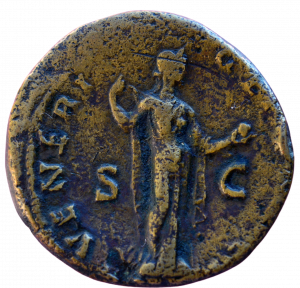
Born around 85 AD, Sabina was the daughter of Matidia Major and Lucius Vibius, and therefore the niece of Trajan’s sister, Marciana.
Not surprisingly, upon the emperor’s death, she inherited his assets, which were added to the brick factories she already owned. This factor had prompted Plotina to encourage the marriage between Hadrian and Sabina in 100 AD. Sabina officially received the title of Augusta around 128 AD, although, according to some provincial sources, it is possible that she had already obtained it a few years earlier.
Although imperial propaganda presented an image of the couple devoted to harmony and Sabina was celebrated as an ideal matron, there are sources that report her poor relationship with Hadrian.
According to the Historia Augusta, for example, the princeps found his wife unbearable and would have repudiated her if he had been a private citizen, while Zonara reports that Sabina voluntarily avoided pregnancy.
On the other hand, we have no information about Sabina’s attitude towards the relationship between Hadrian and Antinoüs, although the deification of the young man after his death took place while the empress was still alive.
Beyond the gossip, Augusta fulfilled her role as imperial consort not only during trips to the provinces (especially those in the east) but also, through her rank, by commissioning the construction of a building dedicated to Roman matrons and establishing an order for them, placed under her protection.
From a political point of view, contrary to what was communicated by official propaganda, Sabina perhaps did not fully support her husband’s decisions: one case in point is Hadrian’s adoption, around 136 AD, of Lucius Ceionius Commodus as his first possible successor.
According to some hypotheses, he may have been the emperor’s natural son or lover, but in any case, he was disliked by Sabina, perhaps because of his kinship with Hadrian’s opponents.
Sabina died shortly afterwards and was subsequently deified, but during her lifetime her image had already been widely adopted on Hadrian’s coins.
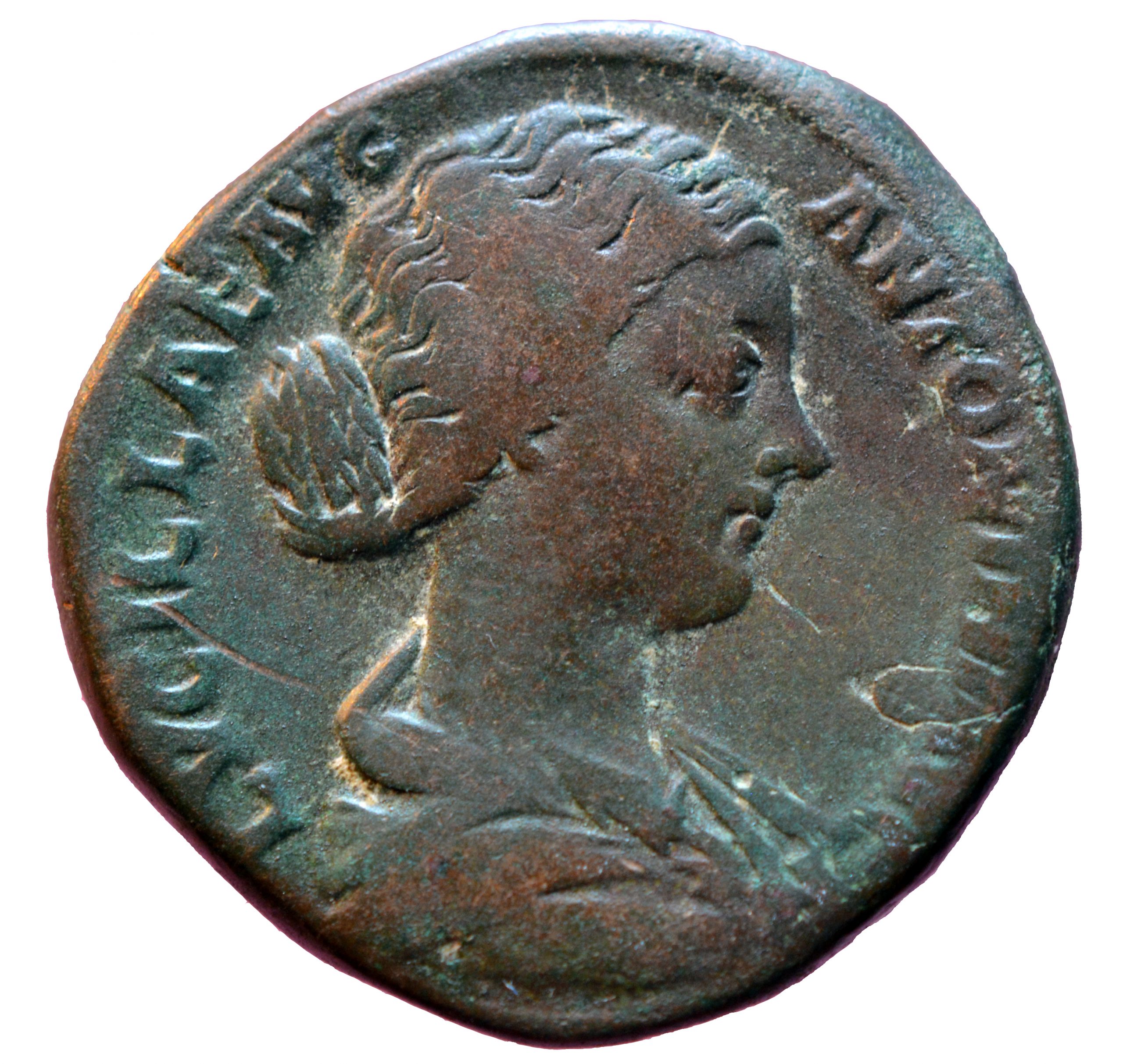
One example is the sestertius (RIC II/3, no. 2596) in orichalcum minted after 128 AD and preserved in the Archaeological Museum of Venice.
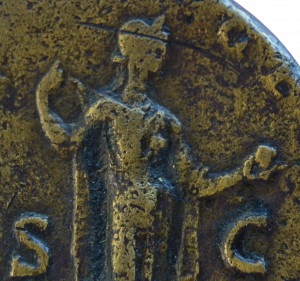
On the reverse, accompanied by the legend VENERI GENETRICI SC, Venus is depicted standing on the right, holding a veil and an apple in her left hand.
Hadrian was particularly attached to this goddess, but it is possible that the association with Sabina was due to an evolution in the role of aristocratic women, who were no longer considered merely political tools but also true life companions.
This was probably a consequence of the establishment of sine manu marriage, which guaranteed greater emancipation for women and partially broke the pattern of the Roman patriarchal family.
On the right, the legend SABINA AVGVSTA HADRIANI AVG PP accompanies the diademed and draped bust of the matron facing right. The depiction of Sabina in her mature years differs considerably from what is considered to be the fashion of the period. She wanted to be portrayed with a hairstyle that reflected the grace and simplicity of Hellenistic female deities, moving away from the elaborate hairstyles of the Flavian and Trajan ladies.
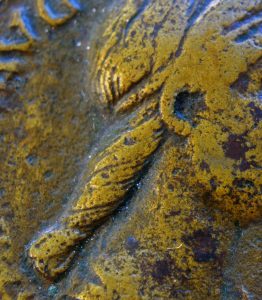
The portrait types of Vibia Sabina have been mainly deduced from coin dies, although scholars have expanded the iconography by hypothesizing that some other portraits were linked to Hadrian’s travels and hairstyles used in private life.
The portrait on our coin certainly highlights the Augusta’s well-known physical features: large eyes, wavy hair, and a pronounced chin and nose.
On the other hand, it immortalizes one of her iconic hairstyles, strongly linked to the classical Hellenistic ideal and comparable to the divine figure of Juno.
Unlike the braided hairstyles seen on other Hadrian coins, this hairstyle features Sabina’s wavy hair held above her forehead by a modest smooth diadem, while a small ribbon appears to surround her head and tie at the nape of her neck. Here, her hair falls, gathered and rolled up, ending with the ends folded inward and knotted.
The image of this Augusta still stands out today for its originality, but it does not seem to have inspired the women of the empire to imitate her.
It is remarkable, however, that it was the personal style of her husband Hadrian that influenced his descendants, with a detail unprecedented in Roman male iconography: the use of a beard in the manner of a Greek philosopher.
Michele Gatto
Patricia Caprino
Bibliography
Adembri B., Nicolai R. M. 2007, Vibia Sabina. Da Augusta a Diva, Exhibition catalog (Tivoli, june 16 – november 4, 2007).
Carandini A. 1965, s.v. Sabina, in Enciclopedia dell’Arte Antica, Roma, pp. 1048-50.
Carandini A. 1969, Vibia Sabina. Funzione politica, iconografia e il problema del classicismo adrianeo, Serie Studi, Accademia toscana di scienze e lettere “La Colombaria”, 13.
Cenerini F. 2014, Dive e donne. Mogli, madri, figlie e sorelle degli imperatori romani da Augusto a Commodo, Imola.
RIC II/3 = R.A. Abdy, M. Amandry, P.F. Mittag, From AD 117-138: Hadrian, London, 2019.
Roman Y. 2011, Adriano, Roma.